Rider position is an important part of riding!
If we are not sitting in the center of the horse, both horse and rider will have problems communicating.
I often see riders frustrated with how their horse responds to their aids. The straightness of the rider is important because the horse will respond to where the rider is sitting (good or bad) before any leg or rein aid.
This means where the rider is sitting is critical!
An example: The rider wants the horse to turn a left circle, the horse is not straight and is falling to the outside instead of turning. This action from the horse drops the rider to the outside, now the majority of the weight is to the outside (horse and rider) which is going to make turning a circle without the reins very difficult.
The solution: move the rider position to the center of the horse (in this case, not following the horse to the outside) and then ask the horse to straighten the imbalance with our aids so they follow the legs and not the hand.
It is important to note: if we continue to follow the horse into this imbalance we will not have a relaxed, sound horse.
We will look at 2 different riders; what they were having trouble with, and what we did to correct it.
The first rider came to my clinic telling me she knew she was leaning left but did not know how to change it.
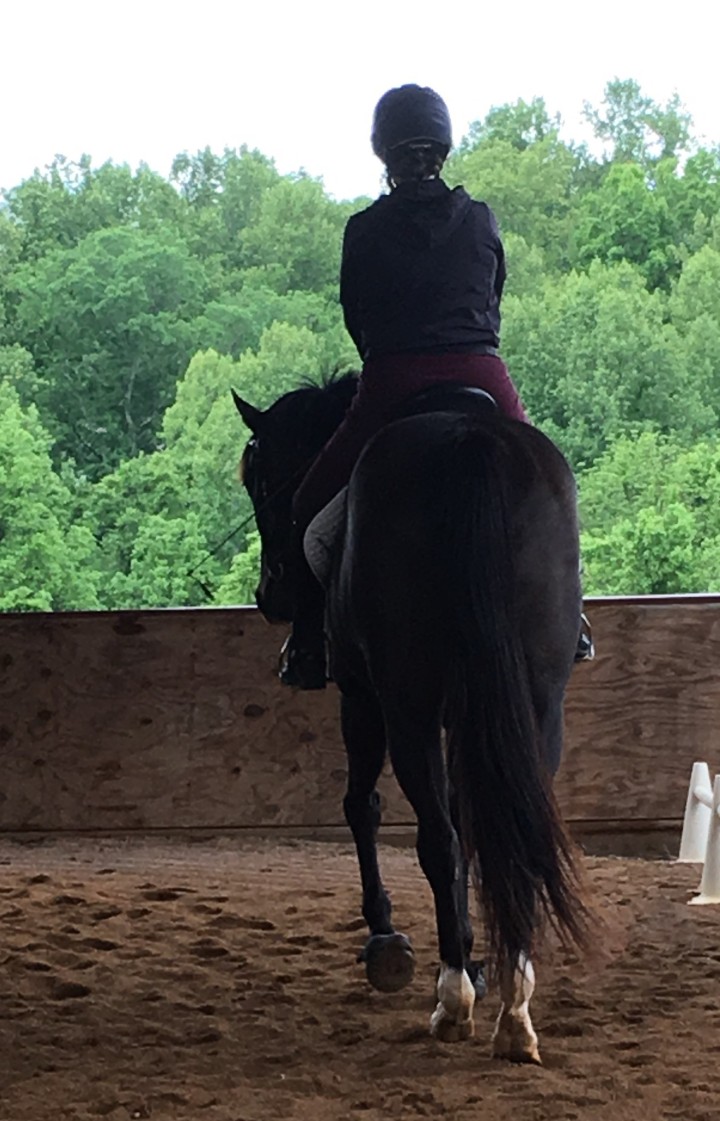
This was great, we could get right down to fixing it! Here is her position when we started:

You can see the horse pushing the rib cage to the right (note the saddle is also to the right). It is this imbalance that is causing the riders reaction of leaning the shoulders to the left.
However, we can not just push with the right leg to straighten the horse if the riders weight is not in the center. That in itself will make the horse fall more to the left.
Later in the lesson:

We now see a straighter rider and horse.
What we did: in the first picture, her hips were uneven (right hip higher, left hip lower). I had her start with opening her hips and thighs and sit more on her bottom (tail bone more under). As humans, we naturally tighten our thighs as a way to stay on, the problem with that is it has a blocking effect in the horses’ back (and isn’t so good for the staying on part!).
Second, I had her think of moving her outside hip down and more to the inside of her saddle, this lifted the inside hip and straightened the rider. It also eliminated the reaction of the shoulders leaning in. In the second photo she isn’t following the horses’ balance to the right, but sitting in the center. It is from this position that she could push with her leg with a good result.
The second rider was having problems with steering and relaxation in her horse. Here is her position when we started:
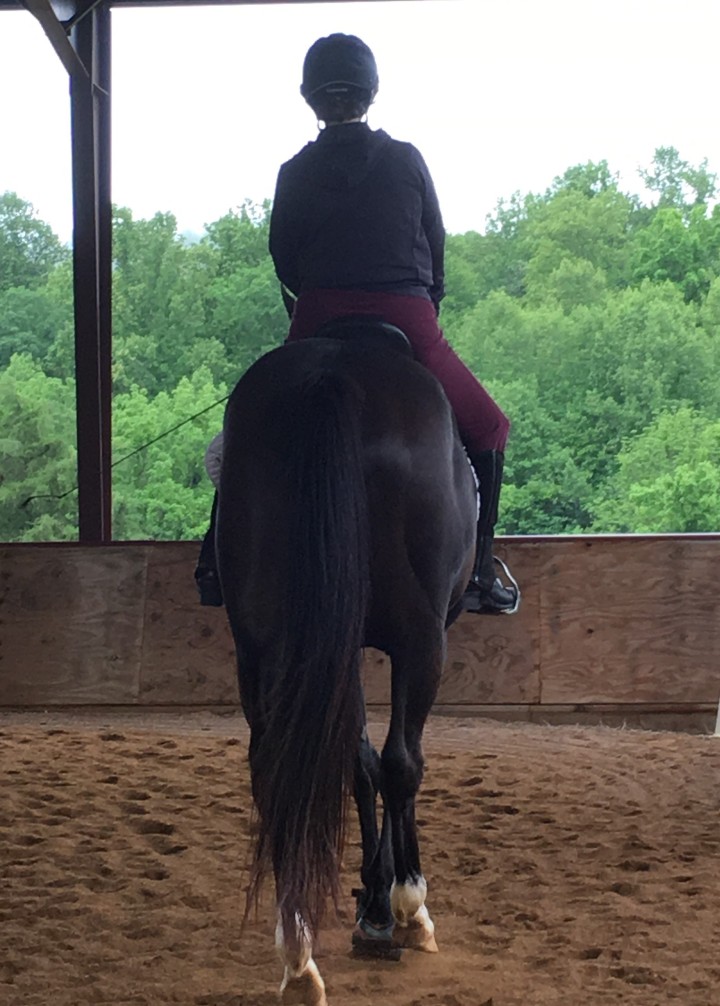
This rider is also sitting too much to the right but we can see the horse is not bulging to the right, but rather loading the left shoulder (falling in). Note the front leg positions. The saddle is also more to the outside.
Here is later in the lesson
We can see the rider is straighter and the horse is lifting the left shoulder a bit more.
What we did:
Similar to the last rider, we worked on opening the thighs and hips. This is an important part with all riders, it allows us to balance ourselves on the horse without imposing on them for our balance.
Second, I had her relax her ankles away from the horse and lengthen her legs from her hip. Her tendency was to close her lower leg in, this created tension and lifted her above the horse in her seat. Third, I had her move her right hip to the left so she was sitting more toward the center.
Don’t forget: it is human nature to close the thighs, we have to retrain our reaction so we sit more relaxed and on our bottom.
Assessing your position plays a big part in communicating with your horse. By straightening ourselves the horse can then understand what we ask.
As always, if you ever have any questions, don’t hesitate to reach out. Always happy to help!
YouTube
© Kim Robare